• Home
  • About us.
    • Mission & Vision
    • Our Team
  • HumanEQ™ Framework
  • What we do
    • HumanEQ™ Product
    • Consulting
    • Narrative Life Coaching
    • Training/Workshops
  • Más
    • Home
    • About us.
      • Mission & Vision
      • Our Team
    • HumanEQ™ Framework
    • What we do
      • HumanEQ™ Product
      • Consulting
      • Narrative Life Coaching
      • Training/Workshops
  • Iniciar sesión
  • Crear cuenta

  • Mi cuenta
  • Iniciaste sesión como:

  • filler@godaddy.com


  • Mi cuenta
  • Cerrar sesión


Iniciaste sesión como:

filler@godaddy.com

  • Home
  • About us.
    • Mission & Vision
    • Our Team
  • HumanEQ™ Framework
  • What we do
    • HumanEQ™ Product
    • Consulting
    • Narrative Life Coaching
    • Training/Workshops

Cuenta


  • Mi cuenta
  • Cerrar sesión


  • Iniciar sesión
  • Mi cuenta

HumanEQ™ Research

Grounded in Research. Designed for Practice.

 HumanEQ™ is grounded in decades of interdisciplinary research across organizational behavior, leadership studies, psychology, adult learning, and ethics. This research consistently demonstrates that empathy, when embedded into organizational systems and leadership practice, improves decision quality, strengthens trust, supports ethical consistency, and sustains long-term organizational performance.


HumanEQ™ does not treat empathy as a personality trait or a soft skill. Instead, it translates established research into a systemic, practical framework that organizations can apply at scale.

Research Foundation (Executive Summary)

 HumanEQ™ is informed by a robust body of academic research showing that empathy enhances sensemaking, perspective-taking, leadership judgment, and ethical awareness, particularly in complex, high-pressure environments. Organizational and leadership research further demonstrates that empathy can be operationalized through system design, decision-making processes, and leadership development, rather than relying solely on individual intention.


These findings are reinforced by executive and practitioner insights from Harvard Business Review, McKinsey & Company, and Forbes, which consistently identify empathy as a critical capability for organizational health, engagement, resilience, and performance.

HumanEQ™ integrates these research streams into a coherent, practical pathway that helps organizations understand people more accurately, design better systems, and sustain leadership and culture over time.

The HumanEQ™ Research Pillars

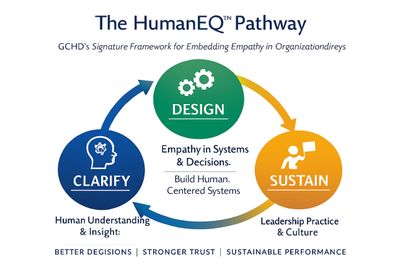
HumanEQ™ organizes its research foundation around three interconnected pillars that reflect how empa

1. CLARIFY: Empathy, Understanding & Sensemaking

 Research in organizational behavior and social psychology shows that empathy strengthens leaders’ ability to understand lived experience, anticipate consequences, and reduce gaps between intent and impact.


What the research shows:

  • Empathy improves perspective-taking and sensemaking
  • Empathetic leadership increases trust and communication quality
  • Lack of empathy contributes to disengagement, resistance, and ethical blind spots


Key academic foundations:

  • Weick, K. (1995). Sensemaking in Organizations. Sage Publications.
  • Decety, J., & Cowell, J. (2014). The relationship between empathy and morality. Trends in Cognitive Sciences.
  • Kellett, J., Humphrey, R., & Sleeth, R. (2006). Empathy and leadership effectiveness. The Leadership Quarterly.


Practitioner perspectives:

Practitioner research emphasizes empathy as essential for understanding employee experience, improving leadership judgment, and strengthening trust, especially in complex and uncertain environments.


Harvard Business Review

  • Goleman, D. (2004). What Makes a Leader?
     
  • Zak, P. J. (2017). The Neuroscience of Trust.
     

Forbes

  • Brower, T. (2021). Empathy Is the Most Important Leadership Skill According to Research.


2. DESIGN: Embedding Empathy into Systems & Decisions

Research shows that empathy becomes most effective when embedded into organizational systems, policies, and decision-making processes.


What the research shows:

  • Empathy-informed decision processes lead to fairer and more trusted outcomes
  • Training and structural interventions can develop empathy-related capabilities
  • Poorly designed systems contribute to burnout and unintended harm


Key academic foundations:

  • Treviño, L., Weaver, G., & Reynolds, S. (2006). Behavioral ethics in organizations. Journal of Management.
  • Lindsey, A., et al. (2015). Empathy and diversity training effectiveness. Journal of Organizational Behavior.
  • Bansal, P., et al. (2018). Organizational design and responsibility. Academy of Management Journal.


Practitioner perspectives:

These practitioner insights focus on how empathy can be embedded into leadership practices, decision-making processes, and organizational systems, moving beyond individual behavior to structural impact.


Harvard Business Review

  • Why Empathy Is a Critical Leadership Skill (2019).
     
  • Leading with Empathy (2020).
     

McKinsey & Company

  • The State of Organizations 2023.


3. SUSTAIN: Leadership Practice, Culture & Long-Term Performance

 Leadership and organizational research consistently shows that empathy is critical for sustaining trust, engagement, and ethical consistency over time.


What the research shows:

  • Empathy supports leadership credibility and resilience
  • Empathetic cultures reduce burnout and turnover
  • Ethical leadership is strengthened by sustained empathy under pressure


Key academic foundations:

  • Barsade, S., & O’Neill, O. (2014). Emotional culture and performance. Administrative Science Quarterly.
  • Hochschild, A. (1983). The Managed Heart. University of California Press.
  • Brown, M., & Treviño, L. (2006). Ethical leadership. The Leadership Quarterly.


Practitioner perspectives:

These sources highlight empathy as essential for sustaining leadership credibility, organizational culture, engagement, and resilience over time—especially under pressure and during change.


McKinsey & Company

  • Organizational Health Index and related leadership and culture insights.
     

Forbes

  • Hunkins, A. (2024). The ROI of Empathy: Improving Business Results and Workplace Culture.
     
  • The Role of Empathy in Effective Leadership (Forbes Books Authors, 2025).


How HumanEQ™ Uses Research

 HumanEQ™ does not replace academic theory or claim ownership over empathy research. Instead, it integrates and applies established research into a proprietary, practical framework designed for real organizational conditions.


Research informs the HumanEQ™ Pathway, while implementation focuses on helping organizations:

  • Clarify lived experience and insight
  • Design systems and decisions with empathy
  • Sustain leadership practice and culture over time

Intellectual Property & Attribution

 HumanEQ™ is the proprietary framework of the Global Center for Human Development (GCHD). It represents an original synthesis and application of established research across multiple disciplines.


All rights reserved.

Copyright © 2026 Global Center for Human Development - Todos los derechos reservados.

  • Privacy Policy

Con tecnología de

Este sitio web utiliza cookies

Usamos cookies para analizar el tráfico del sitio web y optimizar tu experiencia en el sitio. Al aceptar nuestro uso de cookies, tus datos se agruparán con los datos de todos los demás usuarios.

RechazarAceptar